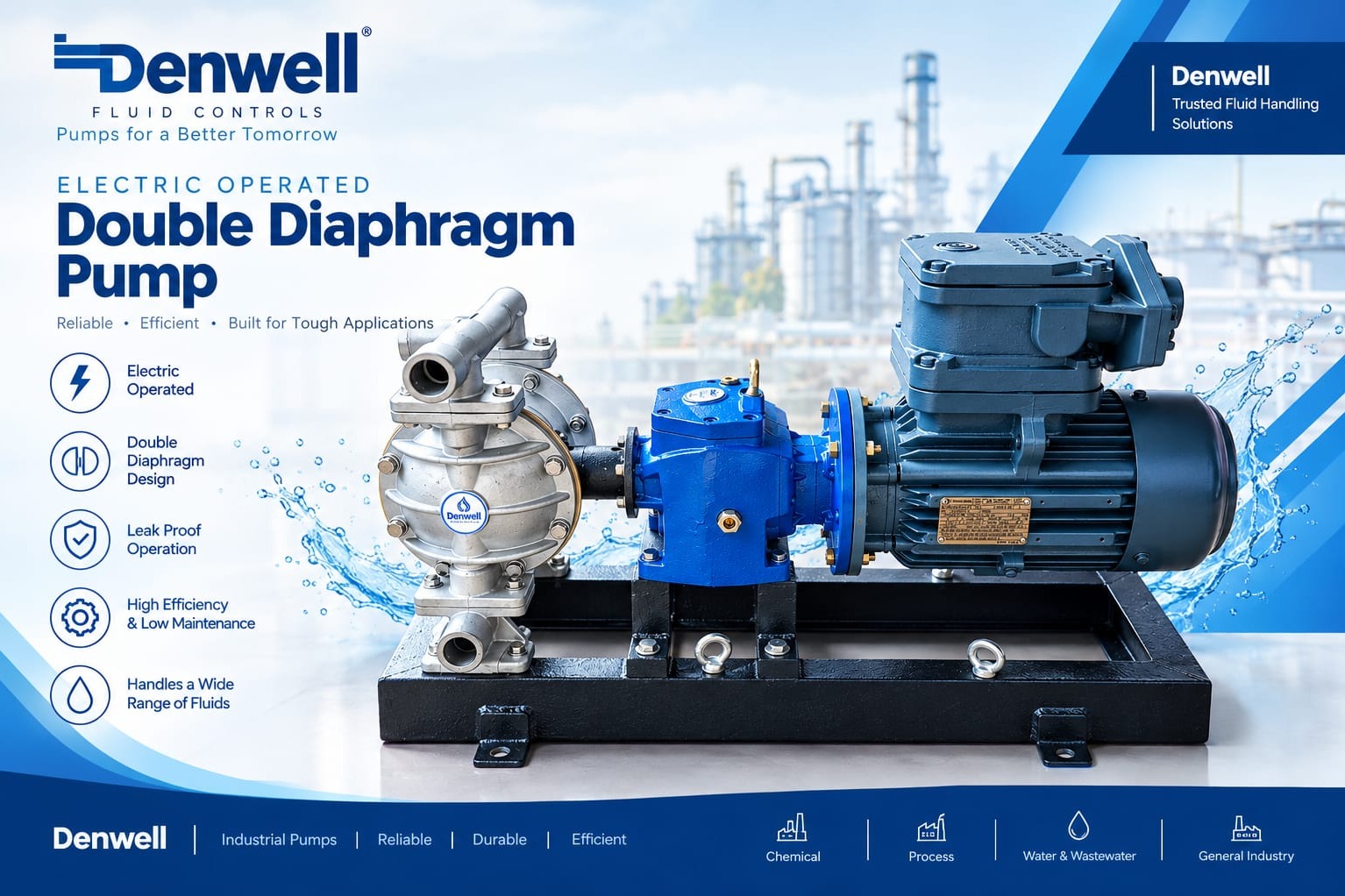
Electric Operated Double Diaphragm Pump – Denwell Fluid Controls
Electric Operated Double Diaphragm Pump
An Electric Operated Double Diaphragm Pump is an industrial fluid handling solution designed for transferring liquids, chemicals, slurries, and other process fluids across a wide range of applications. It uses an electric motor-driven mechanism to operate two diaphragms, creating alternating suction and discharge actions that move fluid through the pump.
Denwell Fluid Controls provides fluid handling solutions for industrial applications where reliable liquid transfer, controlled pumping, and operational efficiency are essential. Electric operated double diaphragm pumps are suitable for chemical processing, pharmaceutical production, wastewater treatment, paint manufacturing, and other industries requiring dependable fluid transfer.
Compared with conventional air-operated diaphragm pumps, electrically operated models can reduce dependence on compressed air and may provide improved energy efficiency in suitable applications. The right pump selection depends on fluid properties, required flow rate, discharge pressure, temperature, and material compatibility.
What Is an Electric Operated Double Diaphragm Pump?
An electric operated double diaphragm pump is a positive displacement pump that uses two flexible diaphragms driven by an electric motor through a mechanical or other suitable drive mechanism.
The diaphragms move alternately within separate pumping chambers. Check valves control the direction of liquid flow, allowing the pump to draw fluid through the suction line and discharge it through the outlet.
Depending on its design and configuration, the pump can handle a variety of industrial liquids, including certain corrosive chemicals, viscous fluids, and liquids containing suspended solids.
Working Principle of an Electric Operated Double Diaphragm Pump
The pump operates through the coordinated movement of two diaphragms and a set of inlet and outlet check valves.
- Electric Motor Operation: The electric motor supplies the mechanical power required to operate the diaphragm mechanism.
- Suction Stroke: One diaphragm moves to create a vacuum in its pumping chamber, drawing fluid through the inlet valve.
- Discharge Stroke: The other diaphragm moves inward, reducing the chamber volume and pushing fluid through the outlet valve.
- Alternating Operation: The two diaphragms continue their coordinated movement to maintain fluid transfer.
- Continuous Pumping: The alternating suction and discharge cycles deliver a positive displacement pumping action.
The actual flow pattern and pulsation level depend on the pump design, drive mechanism, operating speed, and fluid characteristics.
Key Features and Benefits
- Electric Motor-Driven Operation: Reduces dependence on compressed-air infrastructure.
- Double Diaphragm Design: Uses two pumping chambers to support alternating fluid transfer.
- Positive Displacement Pumping: Suitable for applications requiring controlled liquid movement.
- Versatile Fluid Handling: Available in configurations for compatible chemicals, process liquids, and selected slurries.
- Material Flexibility: Wetted components can be selected according to fluid compatibility.
- Reduced Leakage Risk: Diaphragm separation helps isolate the pumped liquid from the drive mechanism.
- Industrial Applications: Suitable for a variety of process, chemical, and wastewater applications.
- Maintenance Accessibility: Diaphragms, check valves, and other serviceable components can be inspected according to manufacturer instructions.
Actual performance, chemical resistance, dry-running capability, and solids-handling capacity depend on the selected pump model.
Applications of Electric Operated Double Diaphragm Pumps
Electric operated double diaphragm pumps can be used in the following industries:
- Chemical Processing Industry: Transfer of compatible acids, alkalis, and industrial chemicals.
- Pharmaceutical Industry: Movement of suitable process liquids and formulated products.
- Paint and Coating Industry: Transfer of compatible paints, coatings, and liquid formulations.
- Wastewater Treatment: Pumping of suitable wastewater and liquids containing suspended solids.
- Food and Beverage Industry: Transfer of compatible products using appropriately certified sanitary configurations.
- Oil and Lubricant Industry: Transfer of selected oils and process fluids.
- Textile Industry: Handling of dyes, pigments, and compatible processing liquids.
- Ceramic Industry: Transfer of suitable slurries and liquid mixtures.
- Printing and Ink Industry: Pumping of compatible inks and liquid chemicals.
- General Manufacturing: Liquid transfer in production processes and industrial fluid handling systems.
Technical Specifications
The following parameters should be considered when selecting an electric operated double diaphragm pump. Actual values depend on the selected model.
Technical Parameter
Details
Product Name
Electric Operated Double Diaphragm Pump
Pump Type
Positive displacement diaphragm pump
Power Source
Electric motor
Pumping Mechanism
Two alternating diaphragms
Flow Rate
Model- and application-dependent
Maximum Discharge Pressure
As specified by the manufacturer
Suction Capability
Depends on pump design and fluid properties
Wetted Materials
Selected according to chemical compatibility
Diaphragm Material
Application-dependent elastomer or other specified material
Connection Size
Model-dependent
Fluid Compatibility
Based on liquid properties and wetted materials
Operating Temperature
According to pump and diaphragm ratings
Main Applications
Chemical transfer, wastewater, and industrial processing
Important: Confirm the manufacturer's datasheet for flow rate, pressure, motor power, diaphragm material, temperature limits, and solids-handling capability before ordering.
How to Select the Right Electric Operated Double Diaphragm Pump
For reliable operation, Denwell Fluid Controls recommends evaluating the following parameters when choosing a pump:
- Fluid Type: Identify the liquid, chemical composition, and concentration.
- Required Flow Rate: Determine the volume of fluid that must be transferred per minute or hour.
- Discharge Pressure: Establish the pressure needed to overcome piping resistance and elevation.
- Viscosity and Solids Content: Check whether the pump is suitable for thick fluids or suspended particles.
- Wetted Material Compatibility: Select suitable body, diaphragm, and valve materials.
- Temperature Requirements: Verify the permissible operating temperature.
- Motor and Electrical Supply: Confirm power rating, voltage, frequency, and area classification where applicable.
- Installation Conditions: Consider suction lift, piping arrangement, and maintenance access.
Why Choose Denwell Fluid Controls?
Denwell Fluid Controls focuses on fluid handling requirements for industrial and process applications. Selecting the correct electric operated double diaphragm pump can help businesses improve transfer reliability and achieve compatibility with their process fluids.
Customers should evaluate pump performance against the actual operating conditions rather than selecting a pump solely on connection size or motor power.
For product selection and technical guidance, share the fluid type, required flow rate, operating pressure, temperature, and material requirements with Denwell Fluid Controls.
Frequently Asked Questions (Q&A)
Q1. What is an electric operated double diaphragm pump?
An electric operated double diaphragm pump is a positive displacement pump that uses an electric motor-driven mechanism to move two diaphragms alternately, drawing fluid into the pumping chambers and discharging it through outlet valves.
Q2. How does an electric operated double diaphragm pump work?
An electric motor drives the diaphragm mechanism. The alternating movement of the diaphragms changes the chamber volumes, while inlet and outlet check valves direct the fluid through the pump.
Q3. What is the difference between an electric operated and an air-operated double diaphragm pump?
An electric operated model uses an electric motor-driven mechanism, whereas an air-operated double diaphragm pump uses compressed air to move the diaphragms. The best option depends on energy costs, available utilities, process requirements, and the operating environment.
Q4. Which liquids can an electric operated double diaphragm pump handle?
Depending on its materials and design, it can handle compatible chemicals, industrial liquids, selected slurries, paints, oils, and wastewater. Chemical compatibility and fluid properties must be checked before selection.
Q5. Can an electric operated double diaphragm pump handle corrosive chemicals?
Yes, selected models can handle corrosive chemicals when the pump body, diaphragms, valves, seals, and other wetted components are compatible with the chemical concentration and temperature.
Keywords